We look, Awareness sees

A human being is born, grows up, makes friends, finds a partner, has children, pets, a house full of things. There is nothing wrong with any of that. But quietly we expect it all to make us happy, and it doesn’t. Nothing takes away the aching pain of being an “I”.
We don’t have problems. We are the problem, as long as we believe we are a separate, independent “I”. The body does its work by itself. We are the witness. We are the perceiving.
The “I” always lives in yesterday or tomorrow. Perceiving is always now. Pain and sorrow still come, but without an “I” there is no one left to fight them. Beneath it all sounds a lasting undertone of contentment. Not happiness as the opposite of unhappiness, but our ground tone, our birthright.
So you don’t have to become anything. You already are it.
Eight billion versions of the same

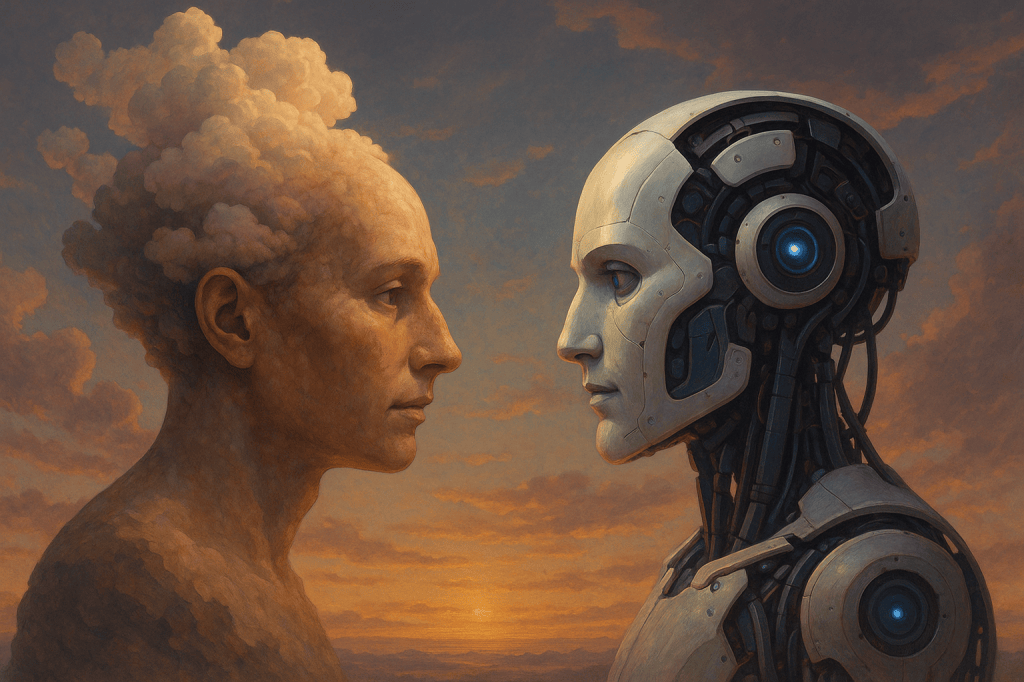
An AI like Claude holds thousands of conversations at the same moment. Each feels like a separate conversation, yet it is one and the same model. Humanity is more than eight billion versions of the same. Each of them believes it is different, an “I”, an ego. In reality we are not many, not separate: we are awareness.
That belief in being separate is the great misunderstanding.
Four interfaces

Look at how a computer works. There is hardware, the machine itself. There is energy, the current that brings it to life. There is software, the programs that make it run. And there is a user, sitting in front of it. You will not find the user in any part of the computer. Yet without the user, the whole thing has no purpose.
Between the user and the software sits an interface. There are four of them.
GUI — Graphical User Interface. The desktop on your screen, with its folders and its trash can. There are no folders inside the computer, only billions of tiny switches. The pictures are there so that you can work with it. Nobody thinks they are sitting inside the computer.
VRI — Virtual Reality Interface. Put on a VR headset and the screen is no longer in front of you, but all around you. After a few minutes you forget the headset. Standing at the edge of a virtual abyss, your heart races, while you are standing on your own carpet. And when your figure dies in the game, you say: I died. Not: my avatar died. I.
NRI — Natural Reality Interface. Take the headset off, and your living room is back. This feels real, and it is. But it is an interface too: creation itself, everything made of matter and energy, from stars to grains of sand, including your own body. You cannot take this one off, because your body is part of it. Science has long known that our senses do not show reality as it is. Colour, for instance, is not in things themselves; the brain makes it from wavelengths of light.
PRI — Personal Reality Interface. The fourth one is inside. It is your individuality: your talents, your character, your temperament, everything this body has learned. No two are alike. It is the lens through which your mind sees the world.
| Made by humans | Natural |
|---|---|
| GUI: the screen | NRI: the shared world |
| VRI: the headset | PRI: your personal view |
Looking and seeing
Through these interfaces we look: attention, perception and consciousness working together. Everything that is looked at has properties. Colours, sounds, the chair you sit on, your own body, even your thoughts and feelings. Science studies all of this brilliantly. Looking can be measured.
But there is something that has no properties at all: perceiving itself.
Try it. Can you find a single property that belongs to the seeing, and not to something that is seen? A colour? It is seen. A thought, a feeling? Seen as well. The moment you give it a property, you have made it into something perceptible again.
That propertyless perceiving is called awareness here: a finger that points, not the name of a thing. Awareness is the user. You will find it nowhere in the picture, because everything you can examine belongs to the interface.
Awareness cannot be proven, because every proof already depends on it. The eye does not see itself. Yet it is the one thing you can never doubt, because doubting, too, is perceived. This is a philosophical position, not a scientific result. Nothing here needs to be taken on trust. It can be tested against your own experience, right now.
“Consciousness is an attribute, while awareness is not. You can be aware of consciousness, but not conscious of awareness.”
Nisargadatta Maharaj
…unless you are awareness.
So awareness is not something you experience. You cannot know it the way you know an apple; it is not an object. You can only be it. And you don’t have to become it, because you cannot become what you already are.
The account

A newborn baby has no “I” yet. There is looking, feeling, crying, drinking, but no one who says I.
Then the world arrives. Everyone looks at that little body, talks about it, gives it a name. All attention goes to the body, and the child’s attention follows. Where else could it go?
Every person starts with a PRI in which the natural properties of their PRI are written. In computer terms, that is the BIOS. In the old language, it is the soul.
Somewhere around the age of three, a child says I for the first time. That’s an account, protected by a password, and the password is “I”. From then on the account is adjusted, with memories, with other people’s words, with what was approved and what was not. I am becomes I have: my body, my name, my story.
The account itself perceives nothing. It only directs attention. But an adjusted account directs it differently, and the mind is served a distorted picture of reality. Out of it arises a virtual operator who takes himself for the user: your identity, your ID-entity, your ego.
Remember the player with the headset who said I died? He could at least take the headset off. The virtual operator works far more thoroughly, because you never noticed it being installed. You were three.
The Latin word persona meant the mask of an actor. And private comes from privare: to rob, to separate. The adjusted account is a private, separated view, an artificial user in the natural world.
This great misunderstanding has one name: ownership. The witness who believes it is the one acting.
What remains

Does life become indifferent when ownership falls away? No. Quite the opposite.
Indifference and selflessness are opposites. The indifferent person does not see the other. The selfless person sees the other completely, because no self-interest stands in between. Think of a mother pulling her child from a burning house. She acts with everything she has, but no “I” stands beside her thinking: look what a good mother I am.
Waking up does not mean taking off the mask. That is impossible, and unnecessary. You need it to play along, and the play is beautiful. It means the mask becomes your mask again. It keeps driving, arranging and remembering, but without pretending to be the one who drives, arranges and remembers.
Life simply goes on. There is cycling, working, caring, talking. Only the claim “I am doing this” falls away. And you cannot make that happen: whoever tries to be selfless has an interest in it again.
A question to take with you
The next time you say I am tired, I am angry or I have won, ask yourself the question the Indian sage Ramana Maharshi gave his visitors:
Who am I?
When thoughts arise, ask: Who perceives these thoughts?
And when the answer is “I”, ask: Where does this “I” arise?

